
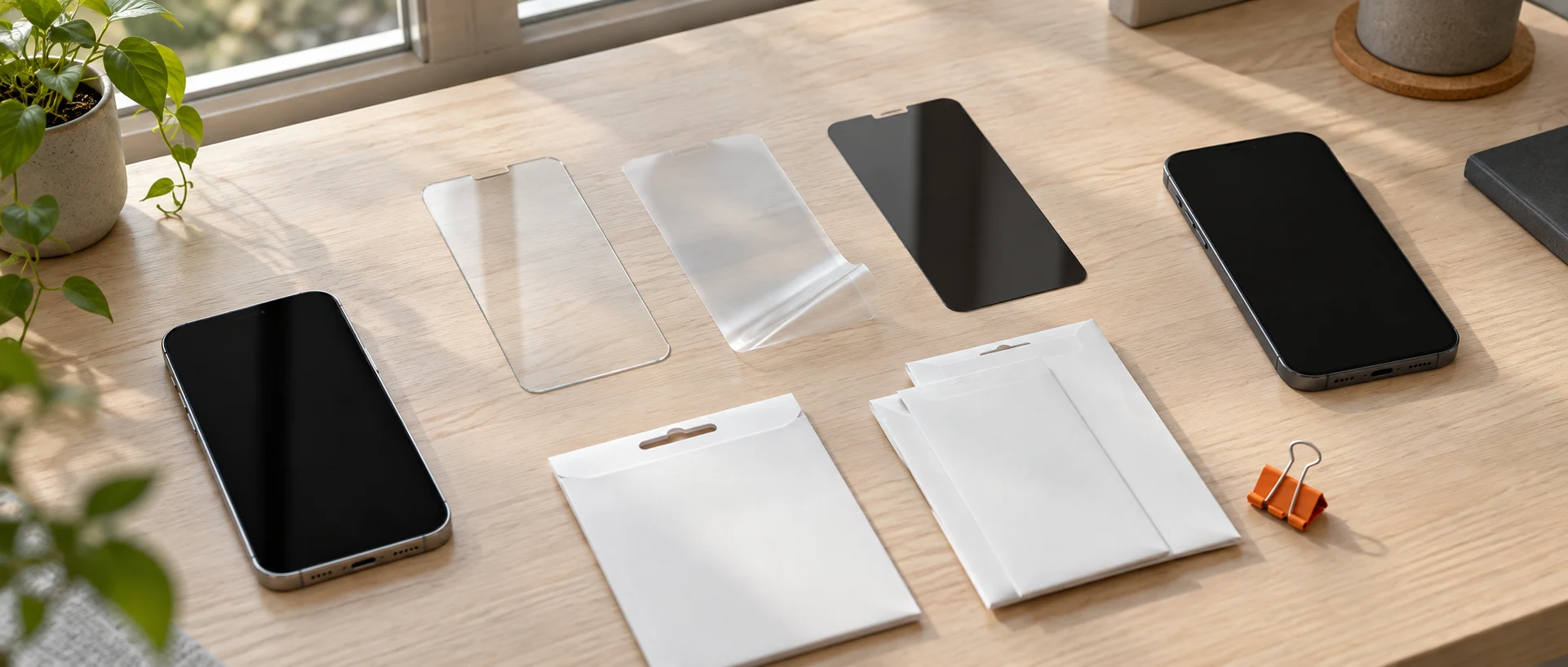
1. Which device models should your first screen protector product line cover?
Plan your first wholesale screen protector product line around confirmed device demand, a small set of distinct customer needs and approved sample installations. Trial the sellable configurations your team can support, record demand and installation results in a SKU sheet, then replenish what earns repeat orders. There is no universal starting SKU count or finish mix for every US repair shop, retailer or distributor.
Start with devices your customers actually bring in or request. For a US repair shop, repair tickets and accessory inquiries are a better starting point than a national phone popularity list. For a distributor, use orders and specific requests from your retail accounts. Record demand you could not fulfill as well as completed sales; sales alone can hide a model that was repeatedly out of stock.
Choose a review period that represents your normal business cycle, then record the exact model, market version, screen position and customer need. “Samsung phone” is too broad for an order. A request for an inner foldable screen is a different product decision from a request for its outer display.
- Repair counter: prioritize recurring devices in repair tickets and ask whether customers want an installed protector after the repair.
- Retail shelf or online store: prioritize model-specific requests and the products customers can identify and install from the package.
- Wholesale distribution: separate demand by account or channel so one retailer’s launch order does not become the forecast for every customer.
Put unconfirmed requests on a candidate list rather than immediately adding them to the purchase order. JJT’s compatibility guidance asks buyers to verify the complete device name, market version, screen position, material and cutting-machine model where applicable. A familiar device name does not establish that a particular protector or template fits it.
1.1 How many SKUs should you launch?
There is no useful universal starting number. Count a separate SKU whenever the fit, material, finish, pack quantity or included installation kit requires separate stock control. Adding every finish to every device can multiply inventory before any of those variants has earned a reorder. For online inventory setup, Shopify’s variant guidance treats each option combination as a variant and describes managing inventory for each variant. This is a platform example; your own stock records still need to distinguish the configurations you actually sell.
For each proposed SKU, write one reason to stock it: repeated local demand, a confirmed account request or a distinct installation need. Keep candidates without a reason available for sampling or quotation, but outside the launch stock list. This gives you a practical range limit without pretending that every shop has the same customer mix.
2. Which materials and finishes belong in your screen protector product line?
Build the screen protector product line around jobs customers can recognize. A clear everyday option, a privacy option and a matte option can represent different needs; they do not automatically form a quality ranking. Each needs its own fit and installation approval on the intended device.
| Range role | Reason to consider it | What must be checked before stocking |
|---|---|---|
| Core clear option | Customers ask for a straightforward everyday protector. | Exact fit, visible display area, touch response, case clearance and repeatable installation. |
| Privacy variant | Customers specifically request reduced side visibility. | Customer acceptance of the display appearance and viewing behavior on the target device, plus normal fit and installation checks. |
| Matte variant | Customers ask for a different surface appearance or feel. | Acceptance of image appearance, touch feel and use under the customer’s usual lighting. |
| Special application | A confirmed request needs a separate device, screen position or installation process. | Device-maker guidance, product suitability, staff capability and demand sufficient to justify separate stock. |
Choose the material and installation system after defining that role. A glass product and a cut-to-order film may both address clear-screen demand, but they create different stocking and service workflows. Use the JJT wholesale product overview to identify candidate families, then compare specific samples. Do not assume a finish is available in every material or model.
If you use “good, better, best” at the counter, define the difference in concrete terms such as the included installation tray, approved fit or a requested finish. Avoid making privacy the automatic premium tier or promising stronger protection from a material name alone. Staff should be able to explain why a customer would choose each option without unsupported performance claims.
2.1 Should you stock pre-cut protectors or cut film on demand?
Use pre-cut stock where repeat demand supports a model-specific item and the pack works for your channel. Consider cut-to-order film for requests spread across many models if your team can identify the device, access the correct template and install the approved material consistently.
On-demand cutting changes what you stock; it still requires usable film, an available machine, suitable templates and installation capacity. Keep material size and finish as inventory items, and record the device served on each job. Before including an unusual model in your advertised coverage, verify the actual machine, template and film combination. A broad database claim is not approval for a particular customer’s device.
3. How should you trial a screen protector product line before a larger order?
Before launching a screen protector product line, separate sample approval from a commercial trial. Samples establish whether the product and installation process are acceptable. A limited sellable order then shows whether customers choose it and whether your team can deliver the service repeatedly. Passing one sample installation does not prove demand.
- Approve the exact configuration. Record the device, protector version, finish, accessories and installation instructions. Test on the actual device with the case customers are likely to use.
- Set acceptance checks. Record alignment, cutouts, visible screen coverage, touch operation, relevant device functions, edges after installation and customer acceptance of the appearance. Follow the applicable instructions and observation period rather than inventing one common standard for all products.
- Check repeatability. Have the staff who will sell or install it use the planned kit. Log failed attempts, wasted units and extra labor so the trial includes service cost.
- Confirm the trial order. Get written confirmation of the sellable quantity, product revision, packaging, price, freight basis and replenishment terms before setting the launch date.
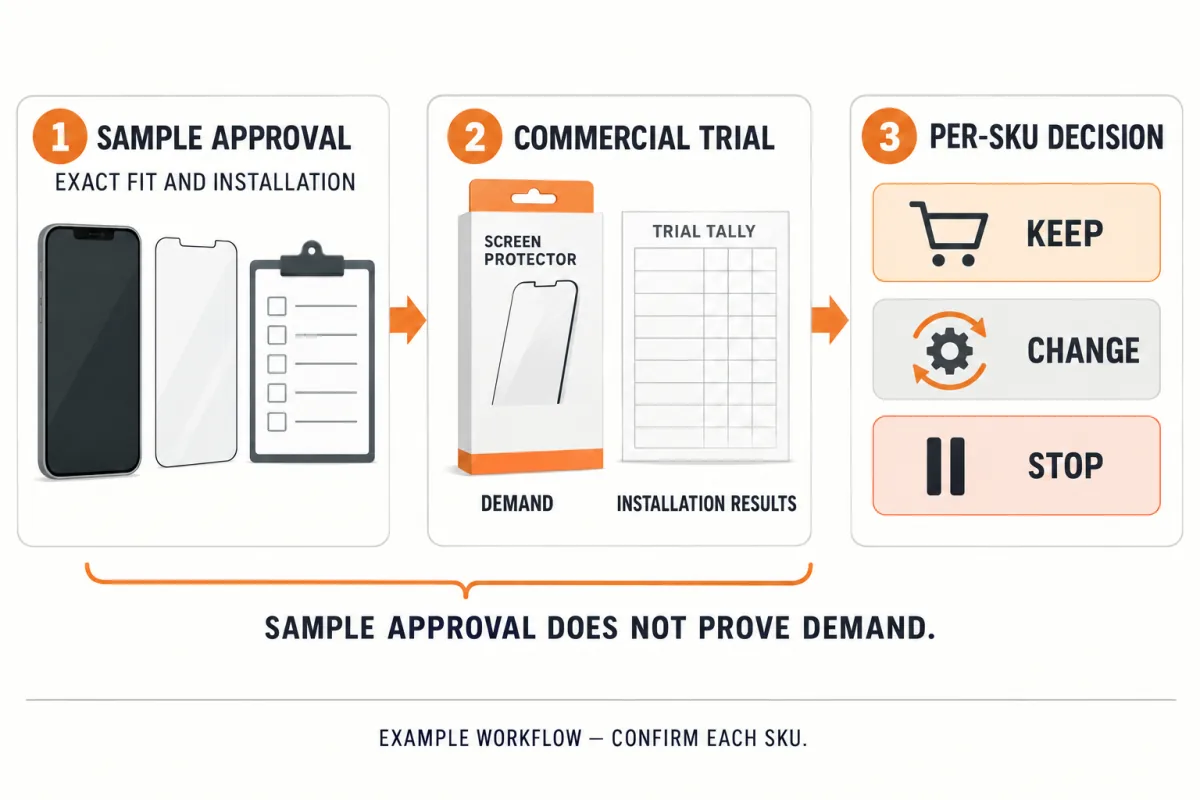
A small trial is a purchasing objective, not a promise that every configuration has a small MOQ. The JJT buyer FAQ, checked October 12, 2026, lists stock non-customized films from 100 pieces and custom OEM/ODM phone protectors at 3,000 pieces per model, with the exact MOQ to be confirmed for the requested models. These are different order scopes. If the configuration exceeds your trial budget, compare a stock option, reduce variants or postpone custom packaging; do not assume mixed models qualify for one shared minimum. The OEM order-planning guide covers the separate quotation and approval stages.
Stop the launch for a configuration with unresolved fit or installation failures. Keep its demand record, but do not blend its failed units into the results of an approved SKU. If the supplier changes the product, instructions or kit, identify the new revision and check the affected acceptance points again.
4. What should a screen protector product line SKU planning sheet record?
Use one row per sellable configuration in your screen protector product line, and keep the fields below together. Copy the blank row for each candidate. For cut-to-order film, keep a stock row for the sheet size and finish, then link job records to the device template used; do not create a finished-stock balance for every possible model.
| Field group | Fill in for each SKU |
|---|---|
| Identity | Internal SKU: ____; supplier item/revision: ____; exact device and market version: ____; screen position: ____; material/finish: ____; pack quantity and kit: ____ |
| Demand evidence | Channel/account: ____; review dates: ____; requests: ____; fulfilled sales: ____; unfilled requests and reason: ____ |
| Approval | Sample reference: ____; installation instructions/version: ____; device/case checked: ____; acceptance result and approver: ____ |
| Trial and cost | Trial quantity: ____; landed cost per usable unit: ____; selling price: ____; installation/rework allowance: ____; quote date and currency: ____ |
| Stock and performance | Opening usable stock: ____; receipts: ____; net units sold: ____; install attempts: ____; accepted installs: ____; waste/returns and reasons: ____; closing usable stock: ____ |
| Next decision | Replenishment lead time: ____; reorder trigger: ____; last reorder/date: ____; next review date: ____; keep / change / stop: ____; reason: ____ |
Record costs on the same basis across variants. Landed cost should use the actual order’s product cost and allocated shipping, import and handling charges, with unusable units accounted for consistently. Installation labor, consumables and rework belong in the service calculation. A cheaper purchase price can be offset by repeated installation failures; a higher selling price does not by itself prove a profitable SKU.
Keep sample and launch lots identifiable. Otherwise, a change in supplier revision or installation kit can look like a change in customer demand. For a distributor, keep retailer reorders separate from the initial shipment into their stores: a large first shipment shows placement, while a repeat order provides additional evidence of demand.
5. Which SKUs in your screen protector product line should you reorder, expand or retire?
Review demand and installation acceptance together for each SKU in your screen protector product line. A product can sell quickly and still need correction if it generates rework or returns. A product can install well and still tie up cash if customers rarely choose it. Set your own review dates and acceptable results before launching, so the decision is based on the trial you planned.
- Sell-through: for a defined period, divide net units sold by opening usable stock plus usable receipts during that period. Keep returns and inventory adjustments consistent, and compare periods of similar length. Record stockout days because unavailable stock can suppress sales.
- Installation acceptance: divide accepted installations by recorded installation attempts, using the same acceptance checks. Keep damaged stock, installation waste, fit complaints and customer preference returns as separate reasons.
- Repeat demand: record the date and quantity of repeat customer or account orders. A promotional trial order is weaker evidence for ongoing stock than purchases that recur without the launch offer.
5.1 What action should each result trigger?
| Result | Next action |
|---|---|
| Repeat demand and acceptable installations | Replenish the proven configuration; check whether the delivery cycle requires a different stock level. |
| Demand is present, but installations fail | Pause expansion, identify whether fit, instructions, kit or operator process caused the issue, then approve the correction before reordering. |
| Installations are acceptable, but demand is weak | Check availability, product explanation and channel placement. If demand remains weak at the next review, reduce stock or retire the variant. |
| Requests recur for a missing model or finish | Add it to the candidate list, verify compatibility and samples, then run a separate trial instead of extending every existing variant. |
Base the reorder trigger for each SKU in your screen protector product line on demand during the confirmed replenishment period plus a buffer suited to your observed variability. Count usable stock and confirmed incoming stock, and subtract committed units. Avoid a fixed buffer copied from another shop when your order cycle, customer mix and shipment reliability differ.
Retiring a SKU means stopping new purchases and deciding how to handle remaining usable stock. Keep its fit records and product identification accurate during any clearance sale. Preserve the reason for retirement so a later request can be assessed against the old evidence rather than restarting the same unsuccessful range.
Once you have a shortlist for your screen protector product line, send JJT the SKU sheet with exact device details, finishes, trial quantities, sample checks, packaging needs and destination. Request confirmation of the proposed starting range and current order terms. The useful outcome is an approved, replenishable assortment that your team can sell and install consistently.