1. Which privacy screen protector format fits the service you sell?
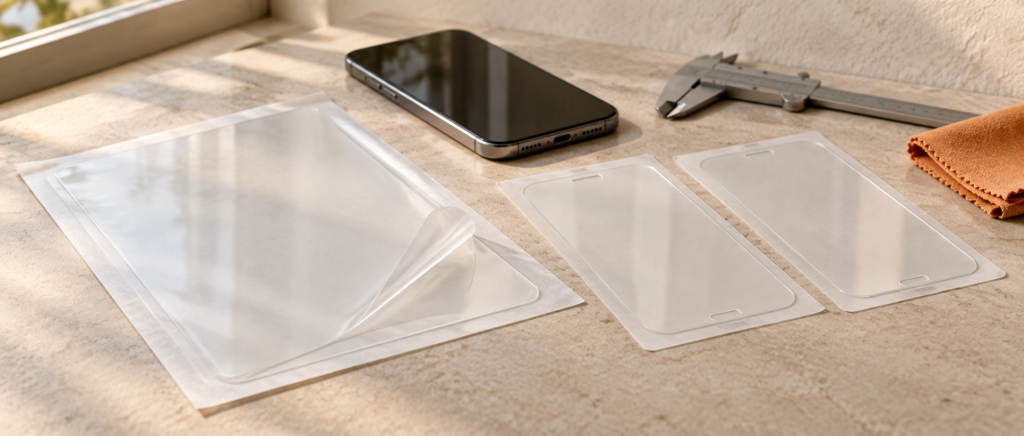
Choose a privacy screen protector format by how it reaches the customer: a finished piece for a known phone, a sheet cut at the counter, or a film that also needs a confirmed UV process. That choice determines your stock lines, equipment and installation routine. “Privacy” describes the viewing function; “glass,” “TPU” and “UV film” identify different product and process choices. None of those names alone establishes fit, fingerprint compatibility or an acceptable viewing result.
For a store with repeat demand for a small set of models, pre-cut privacy glass is a practical candidate to sample. For a repair counter serving a changing device mix, privacy cutting film is worth evaluating when the relevant files and machine settings are available. Add UV privacy film only when the exact privacy item and its curing instructions are confirmed. These are purchasing starting points, not measured performance rankings.
| Format | What you stock and do | What must be checked first |
|---|---|---|
| Pre-cut privacy glass | Keep finished pieces by exact device model; clean, align and apply using the selected product’s method. | Outline, adhesive specification, case clearance, sensor openings and included installation accessories. |
| Privacy cutting film | Keep identified film blanks; select a device file, cut and install the finished outline. | Blank dimensions, liner construction, cutter settings, current file availability and privacy-filter orientation. |
| UV privacy film | Order cutting sheets or finished film and follow an additional product-specific UV process. | Explicit privacy specification, supply format, compatible equipment and documented curing sequence. |
For the viewing mechanism and directional privacy questions, read how privacy screen protectors work. This guide focuses on choosing and buying a format your team can deliver consistently.
2. What stock and installation checks does each privacy screen protector format require?
2.1 Pre-cut glass: approve the model and the kit together
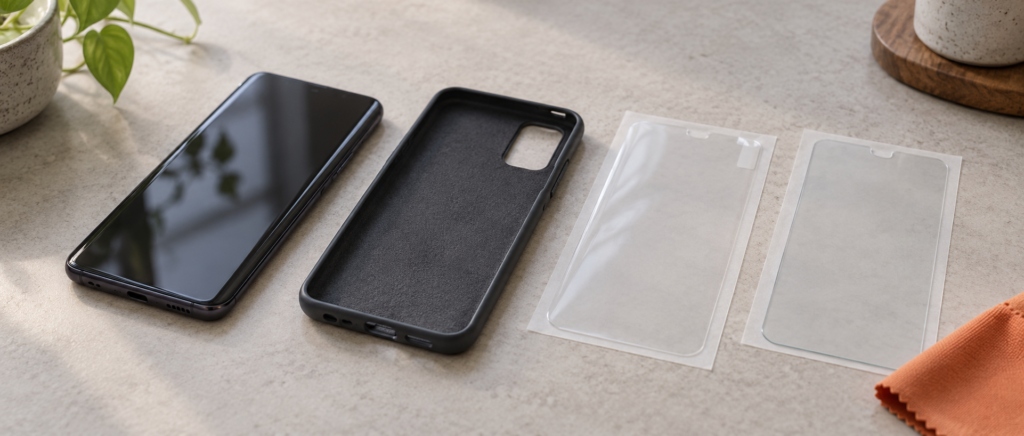
Pre-cut glass is already shaped, so the purchasing unit is the exact device-specific piece. Split the order by full model name and privacy finish; a shared generation name is not evidence of a shared outline. Keep the glass label, sample phone and any alignment tray matched during approval.
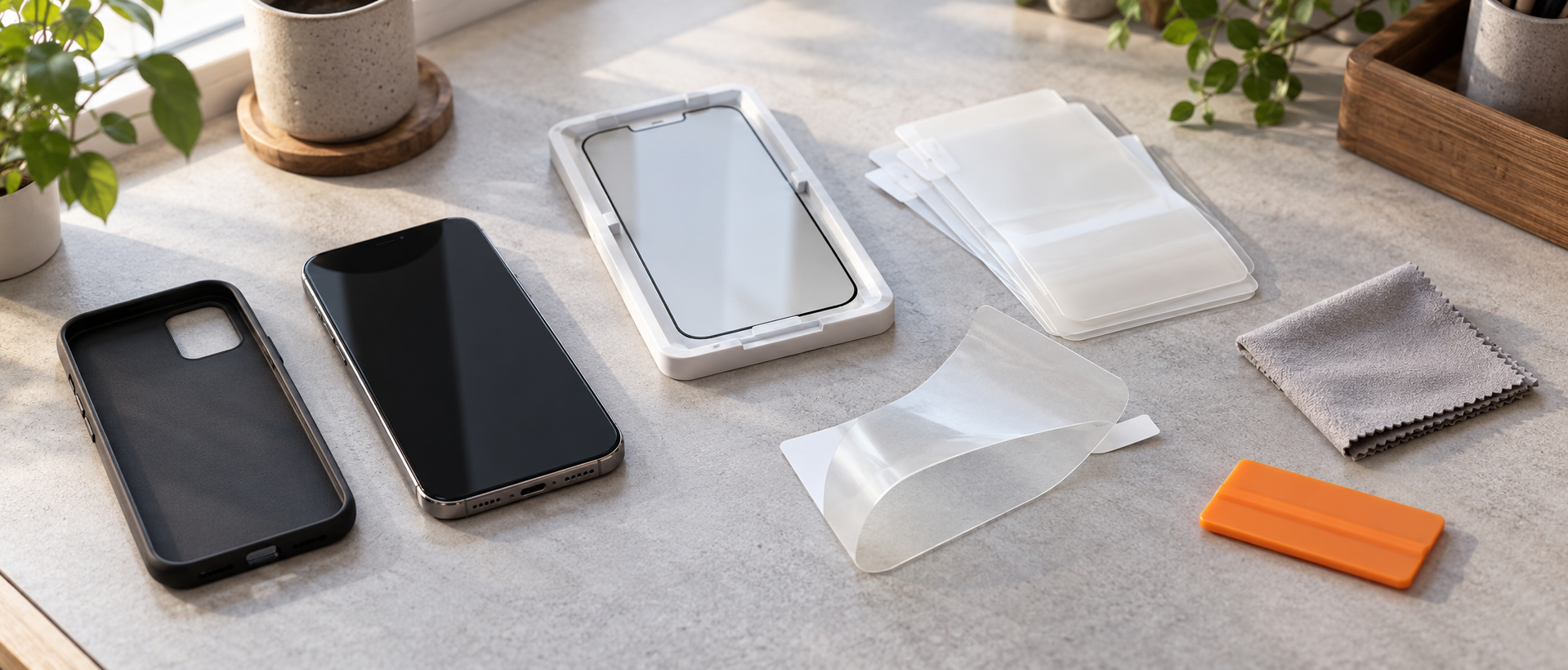
JJT lists iPhone privacy tempered glass with glass-only supply and an optional installation housing. The housing and pack contents need their own confirmation. Do not build a retail promise around an accessory that appears in a photograph but is absent from the agreed bill of materials.
A tray can organize alignment, but it does not remove preparation work. Belkin’s privacy-protector installation guide still calls for removing the case and old protector, cleaning and dust removal before using its model-specific tray. Use the instructions belonging to the product you buy; that example is not a JJT installation procedure.
2.2 Cutting film: validate the blank, cutter and file as one setup
A blank lets you postpone the finished outline until a customer’s device is known. It does not eliminate inventory: your store still holds film variants, liners and installation supplies. Separate privacy blanks from plain matte or clear blanks so the correct finish is selected before cutting.
One confirmed JJT example is Korean TPU matte privacy film, 0.15 mm, listed in cutting and pre-cut formats. The item identity and thickness are catalog specifications, not proof of a particular privacy angle or of compatibility with your plotter. Agree sheet dimensions and make a sample cut for the actual machine and device file.
For a cutter already in your shop, record the make, model, software version, blank size and proposed material settings. Check feeding, tracking, complete outline separation and liner release before installing on the phone. Keep the privacy-filter orientation consistent with the approved sample; do not rotate the blank simply to fit more shapes without checking the viewing behavior.
Mietubl’s machine guidance, for example, says other brands’ cutting materials may need parameter adjustment because its defaults match its own materials. This supports checking the full setup; it does not establish that JJT blanks work in every cutter. A model name in a database also does not prove the chosen outline fits the customer’s case.
2.3 UV privacy film: confirm a specific item and its process
UV film belongs on the shortlist only when the proposed product is explicitly a privacy film. JJT’s Korean UV matte privacy film, 0.25 mm is a confirmed catalog item. Its page identifies cutting and pre-cut supply and requires matching the cutting and UV equipment. It does not publish a viewing-angle figure or a curing time, wavelength or dose.
UV-curing film and glass installed with liquid UV-curing adhesive are different constructions. A glass kit with a liquid adhesive bottle is not evidence that a film uses that adhesive or the same procedure. Before a sample run, obtain the exact item’s liner sequence, application method, equipment requirements and UV instructions. Keep those instructions with the sample record; never copy exposure settings from an unrelated glass kit.
If the item-specific instructions are unavailable, hold the UV option out of the trial and compare the confirmed alternatives first. The missing process is a concrete purchasing gap, not a reason to improvise a curing recipe.
3. Test the finished installation with the customer’s case and sensors
A factory foldable inner display needs a separate service decision before adding a privacy option. Samsung’s US Galaxy Z series service guidance recommends against self-removal of its main-screen film. For any foldable, check the device maker’s model-specific instructions rather than applying the ordinary external-screen workflow.
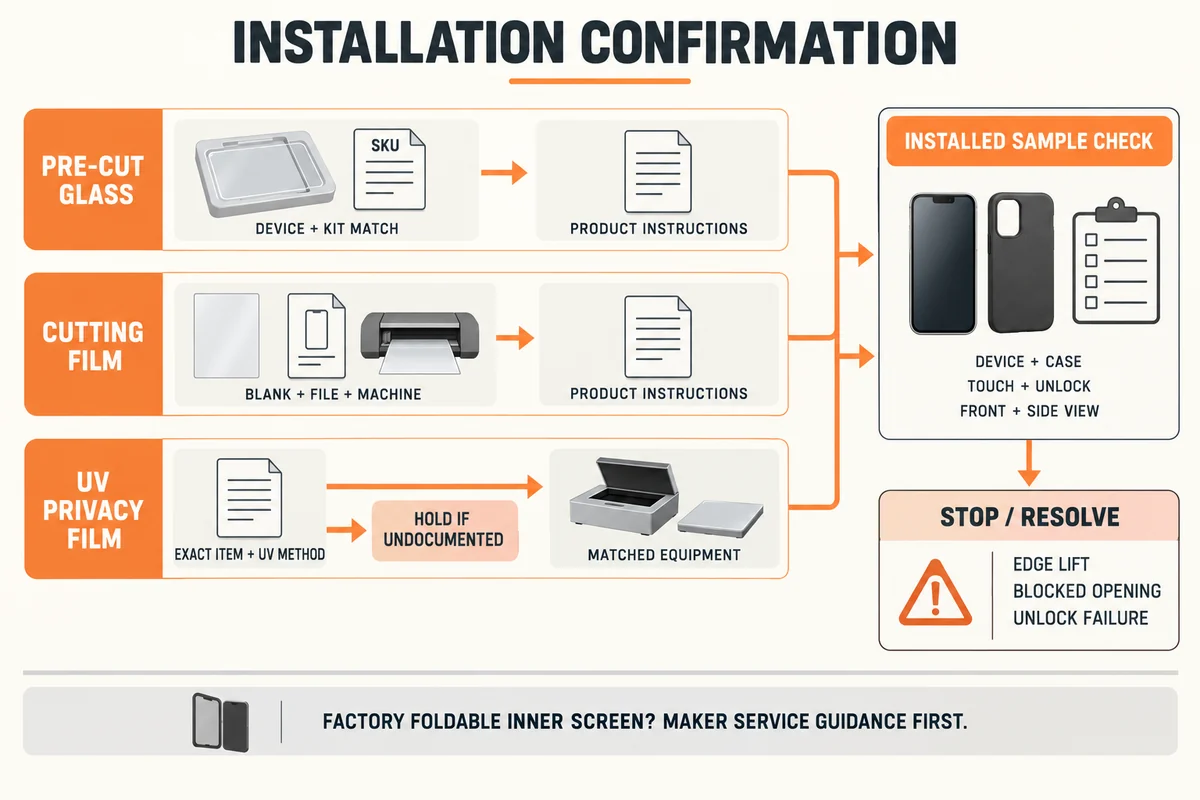
Judge the installed protector on the actual phone, with the case the customer intends to use. First check the phone without a case for alignment, camera and sensor openings and clean edges. Refit the case, operate the side buttons and inspect whether the lip presses or lifts the protector. Record the case model as well as the phone model: “case friendly” without that pair is too broad for sample approval.
Check touchscreen typing, edge gestures and the device’s normal unlock method before and after application. For in-display fingerprint readers, follow the device maker’s guidance rather than assuming either glass or flexible film will pass. Samsung’s fingerprint troubleshooting guidance warns that an uncertified protector covering or touching the in-screen sensor may interfere with recognition. Re-enrollment may be appropriate under the maker’s instructions; it is not a compatibility guarantee.
Keep display content, brightness setting, ambient lighting and viewing positions consistent when comparing samples. Review front-view reading comfort as well as side-view discretion, and repeat in portrait and landscape for the use your customers expect. A protector that appears darker from the side can still be unsuitable if the primary user dislikes the installed view.
- Identify the sample: item, batch reference, phone model, screen position, case and supply format.
- Record the process: installer, cutting file and settings if used, and confirmed UV equipment and instructions where applicable.
- Inspect the fit: openings, outline, edge contact and case clearance.
- Check operation and viewing: touch, gestures, unlock and the agreed front and side viewing conditions.
- Recheck after normal handling: note any edge lift, residue or viewing complaint at an agreed follow-up point.
Stop approval if the case lifts an edge, an opening is obstructed, normal unlocking fails or the UV process is undocumented. Resolve that specific failure before enlarging the order. Keep the approved finished sample and its process record as the reference for later supply.
4. How should you compare the finished installation cost of each privacy screen protector format?
Compare quotes on the same basis: the protector supplied, preparation materials, installation accessories, cutting consumables where used, UV equipment where required, packaging and delivery terms. A price per blank and a price per packed glass piece represent different inputs. Neither tells you the cost of completing the service.
During the trial, record actual staff time, rejected cuts, failed applications and accepted installations. Divide the trial’s material and labor cost by the number of accepted installations using your own labor rate. Track equipment allocation and shipping separately if you include them in the commercial comparison. This produces a store-specific estimate without inventing a universal margin or payback period.
- Repeat-model counter: sample pre-cut glass and its proposed kit against your current installation routine; measure the full preparation and handover time.
- Mixed-model repair shop: trial privacy blanks on the device files you actually need, including less common models, before allocating a larger sheet order.
- Store considering UV service: check the additional equipment, documented process and staffing time in a controlled sample run before adding it to the standard menu.
These are planning scenarios, not JJT customer case studies or tested savings. A blended assortment may suit a store better than replacing every protector with one material, provided each line has a clear device and process specification.
5. Turn the sample result into a focused quote request
Send a quote brief that reproduces what passed the trial. Name the product and finish, not just “privacy hydrogel.” Distinguish cutting blanks from finished protectors, and split quantities by model where finished pieces are required. For UV privacy film, attach the agreed process and equipment details so a substitute clear UV item cannot be mistaken for the approved specification.
| Order detail | What to provide |
|---|---|
| Device and fit | Exact model and market version, screen position, tested case and approved outline. |
| Product identity | Glass or film item, privacy finish, thickness specification and sample reference. |
| Supply and equipment | Pre-cut pieces or blank dimensions; cutter and file details; UV equipment and confirmed process if required. |
| Commercial scope | Quantities by line, included accessories, packaging, destination, currency, shipping terms and required delivery date. |
| Acceptance | Approved sample, agreed viewing conditions, fit and operating checks, and how specification changes will be reviewed. |
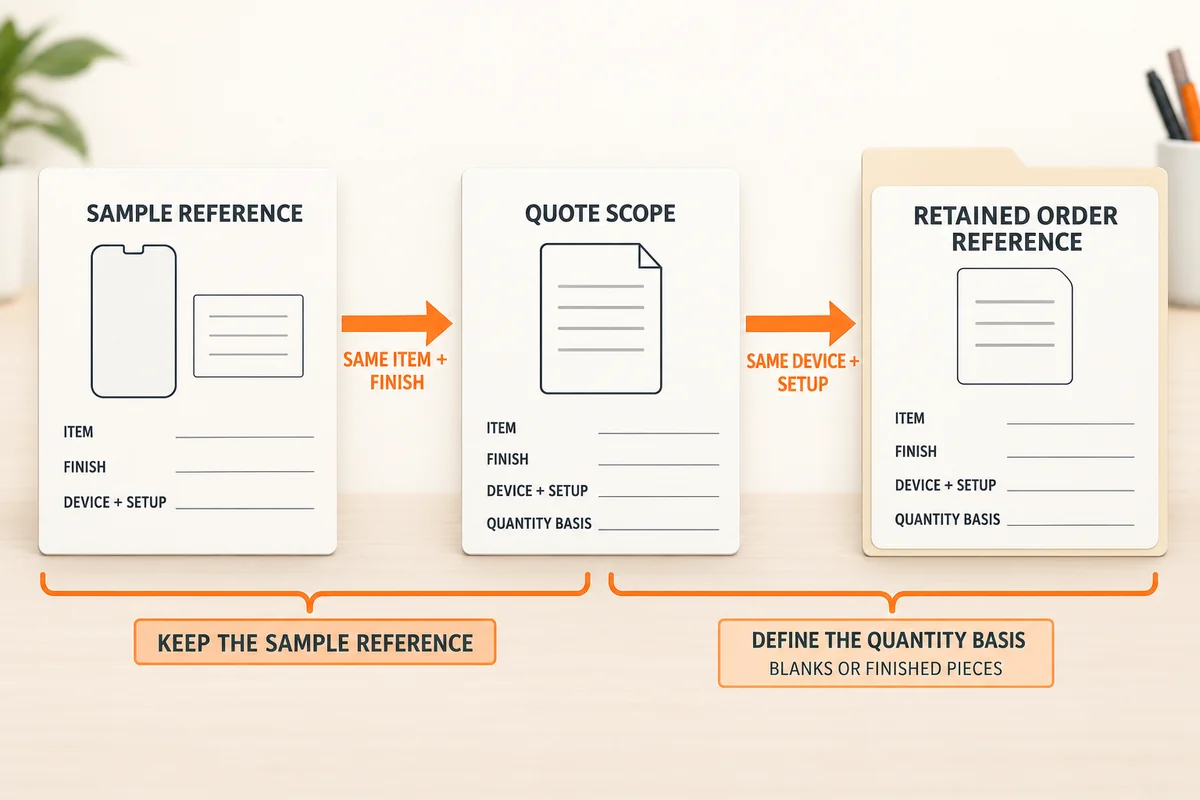
Request written confirmation of the item, current availability, minimums, sample charges and lead time for that order. Retain the approved sample before placing a trial order, then use installation records and actual demand to decide whether to expand the range. Browse JJT’s current model catalog for a starting point and send the completed brief through Contact JJT.