1. What Does the Screen Protector Thickness Number Include?
Compare screen protector thickness on the same layer basis before choosing a product for your shop or wholesale order. A listing that says “0.3 mm” without naming the included layers is incomplete. Before comparing it with a 0.2 mm or 0.4 mm offer, establish whether each number describes the base glass or film, the finished protector including adhesive and coatings, or the supplied sheet with removable liners.
Those are three different purchasing specifications. The liner is removed during installation, so the thickness of a supplied sheet does not describe the height left on the customer’s phone. Conversely, a base-material value leaves out anything added to make the finished protector. Keep the supplier’s original wording in your comparison sheet until the measurement basis is confirmed.
| Quoted basis | What to clarify | Useful purchasing question |
|---|---|---|
| Base glass or film | Adhesive and surface coatings excluded or included? | What is the finished protector thickness after removing temporary layers? |
| Finished protector | Which permanent layers are included? | Does this match the sample supplied for device fitting? |
| Supplied sheet or stack | Release liner and removable top film included? | Which layers are removed before or after installation? |
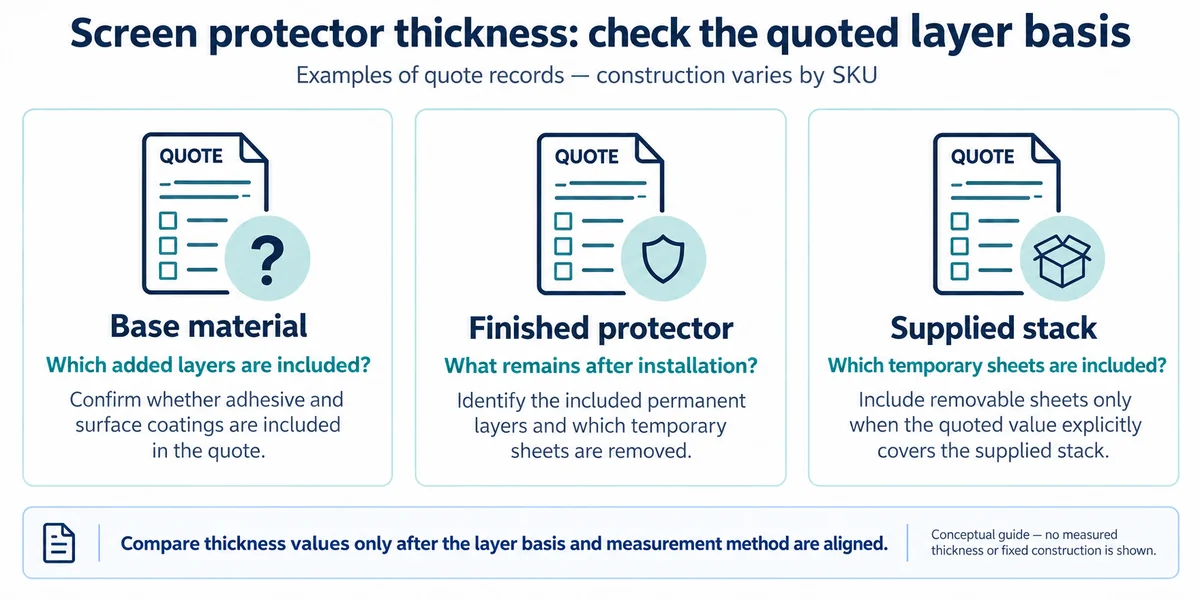
These distinctions define a comparison method; they do not establish the construction of an unnamed product. Get the layer inclusions in writing for the exact SKU.
2. Is 0.2, 0.3 or 0.4 mm Better?
There is no universal best thickness among these three labels. If two protectors have the same measurement basis, the lower number describes less measured thickness. It does not independently establish better fingerprint recognition, greater clarity, easier installation or lower breakage. Select the finished product that passes the checks relevant to your customers.
Published products also do not divide neatly into three standard thickness classes. Belkin’s UltraGlass Treated product page for iPhone 14 Pro Max, P-OVA036 advertises 0.29 mm. Mous’s Tempered Glass iPad Screen Protector page states 0.3 mm and limits use to the specified iPad fit. These are product-specific published values, not independent measurements or evidence that either thickness suits another device. Neither cited thickness statement supplies a complete layer-by-layer measurement method.
For impact-related claims, request the applicable test method, sample construction and comparison conditions separately. Glass treatment, construction and the test setup must accompany a performance claim. Do not convert a thickness difference into a strength ranking, or tell a customer that thicker glass guarantees their display will survive a drop.
3. Check Case Clearance and Cutouts on the Installed Sample
Approve thickness with the actual protector outline and the cases your shop sells. A nominally thin protector can still interfere with a case if its edge extends into the case lip. A thicker sample with a different outline may fit that same case. The practical check is the installed combination, not the thickness label alone.
- Case lip: Fit the case normally and check all edges and corners for contact, pressure or lifting. Recheck after ordinary handling.
- Display coverage: Inspect the edge against the intended screen area. Confirm that printed borders or the protector outline do not obscure content.
- Cutouts: Check alignment with the earpiece, front camera and any areas specified by the device or protector manufacturer.
- Curved areas: Look for incomplete contact or lifting where the protector meets the display shape. Record the exact phone and case combination.
If an edge lifts when the case is fitted, stop approving that combination. Compare the outline, placement and adhesion with the product’s instructions before ordering a different thickness. Reducing the number on the specification sheet may leave the actual interference unresolved.
4. Verify Touch and Fingerprint Functions Separately
Touch response and fingerprint recognition are separate acceptance checks. Test both on the target device after installation; passing ordinary scrolling does not prove that the fingerprint sensor works reliably.
Samsung’s US fingerprint troubleshooting guidance says an uncertified protector can interfere with an in-screen fingerprint sensor and that fingerprints may need to be registered again after replacement with a non-certified protector. For additional physical factors, Samsung’s UK guidance identifies pattern, thickness and material, while its Africa-region guidance identifies air gaps or foreign matter. The regional pages add physical context; none supplies a universal safe thickness in millimeters.
- Record the phone model and software version, and establish normal touch and unlock behavior before installation.
- Install the exact candidate according to its instructions. Inspect the sensor area for damage, contamination and incomplete contact.
- Check typing, edge gestures and taps in different screen areas. Check fingerprint enrollment and repeated unlock attempts separately, following the phone manufacturer’s instructions.
- If a function fails, pause approval. Confirm the product’s stated device compatibility and installation requirements before testing a replacement candidate.
A shop’s sample record should describe what was tried and what happened. It should not become an “all Galaxy models compatible” claim or a promise that a particular thickness always works.
5. Compare Film and Glass Without Treating Material Names as Thickness Standards
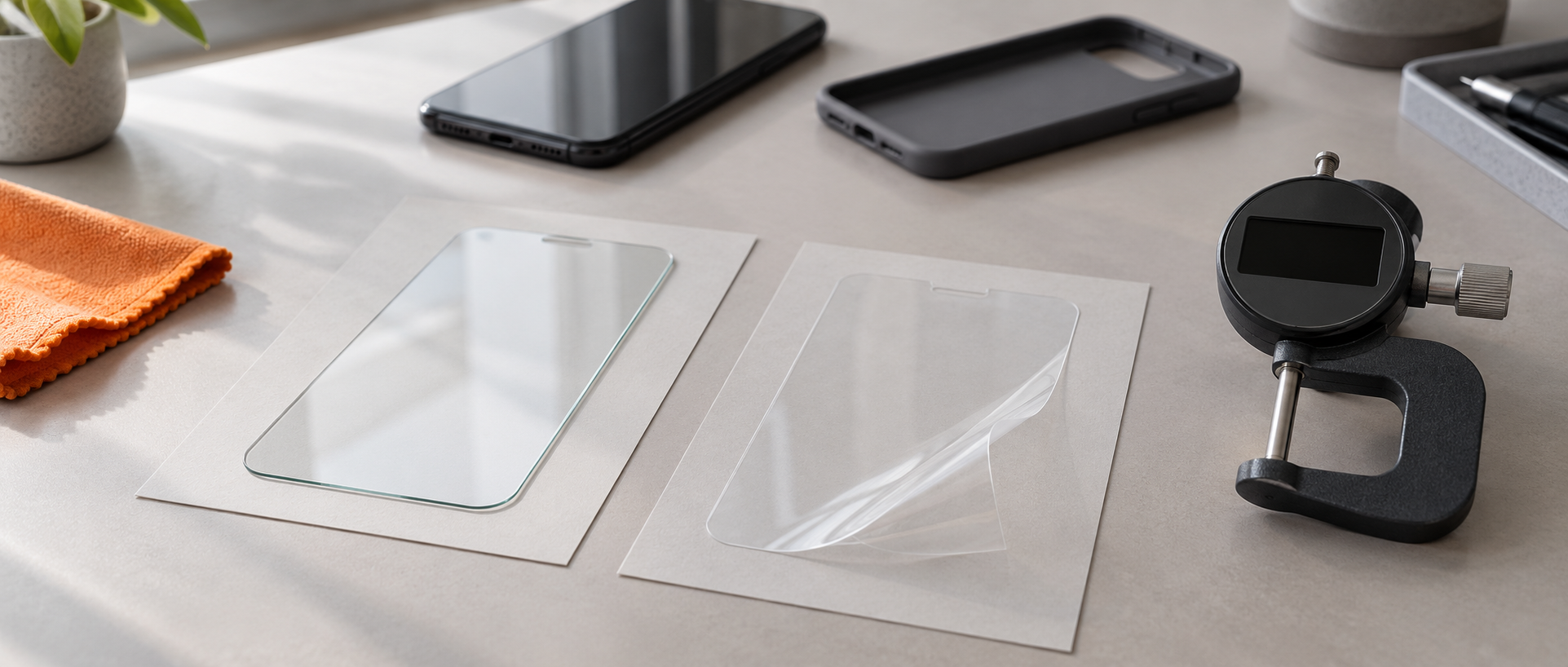
Buy by the exact material SKU and finished construction. “TPU,” “EPU,” “PET” and “tempered glass” are insufficient purchase specifications on their own. A material name does not define the thickness basis, removable liners, adhesive arrangement or device fit.
For example, JJT lists Korean TPU HD Clear at 0.14 mm, Korean EPU HD Clear at 0.18 mm and PET 5H HD Clear at 0.33 mm. Those are catalog labels whose thickness basis is not specified. They are not JJT measurement results, universal thicknesses for those materials, or proof of cutting-machine compatibility. Use them to identify the catalog options, then confirm the exact sample construction before comparing them with another supplier’s figures.
For sheets used in an on-demand workflow, distinguish the supplied stack handled by the equipment from the protector left on the screen. Confirm the material SKU, liner arrangement and approved machine workflow separately. A finished-protector thickness number does not establish a cutting setting.
6. Agree on a Measurement Method Before Comparing Samples
A useful screen protector thickness comparison needs the same layer basis and a repeatable measurement procedure. Ask the supplier for the instrument, contact arrangement, measuring force, measurement locations and tolerance used for its specification. Record your method alongside your own readings rather than presenting a different procedure as a direct verification of the supplier’s number.
Measuring force matters for materials that deform under contact. Mitutoyo’s Litematic VL-50-B/50S-B technical brochure describes low, constant-force measurement for delicate workpieces and thickness or height measurements affected by measuring force. This supports choosing a method suited to the sample; it does not prescribe a screen-protector tolerance.
- Identify the sample SKU and lot, and state which temporary layers remain in place.
- Use clean measuring faces and check the instrument according to its instructions. Avoid confusing display resolution with verified accuracy.
- Measure agreed locations away from cutouts or shaped edges unless those locations are part of the specification.
- Keep the individual readings and the observed range. Do not invent a tolerance from one sample or round unlike results into the same nominal class.
Do not strip permanent layers from a finished sample merely to estimate base thickness. If a base-material figure is needed, obtain the corresponding specification or agreed test sample. If your readings disagree, reconcile the layer basis and measurement procedure before rejecting the shipment.
7. Put the Approved Thickness Basis in the Sample and Quote Request
For a US store or distributor, approval should connect the supplier’s quoted SKU to a sample, a measurement basis and a device-fit record. Keep those references with the order so a later substitution can be assessed against the same requirements.
| Request field | Information to provide or obtain |
|---|---|
| Product identity | Material, supplier SKU, intended device models and approved sample reference |
| Thickness | Nominal value in mm, included/excluded layers, and supplier-confirmed tolerance |
| Measurement basis | Instrument, force/contact method, locations and sample condition |
| Installation and fit | Instructions, case models, outline/cutout version and functional checks |
| Quote scope | Order quantity, finished protectors or sheets, packaging and included installation accessories |
| Changes | How a change to construction, thickness basis or outline will be identified before supply |
7.1 A Sample Request You Can Adapt
“Please quote [SKU/material] for [device models and quantity]. State the nominal thickness and tolerance, and whether adhesive, coatings, release liner and removable top film are included. Supply samples with the same construction and outline as the quoted product, along with installation instructions and your thickness measurement method. We will evaluate them with [case models] and record touch, fingerprint and edge-fit results before approving the order.”
When requesting samples or a quotation from JJT, include your target devices, cases and whether you need finished protectors or material sheets for an existing workflow. The next useful step is a clearly identified sample and comparable specification. Approve that combination on the evidence you collect, rather than selecting the thinnest or thickest catalog label.