
Quick answer
The main screen protector materials are tempered glass, PET film and flexible polyurethane-based films such as TPU and many hydrogel products. Privacy, matte, paper-feel and clear describe surface functions, while UV usually describes an adhesive-and-curing installation system. The best type depends on the device shape, protection priority, display feel and replacement model.
- Choose the base material before comparing functional finishes.
- Match the protector to flat, curved or foldable display construction.
- Ask what a “ceramic” or “hydrogel” product is actually made from before approving a wholesale specification.
1. The Four Layers of a Screen Protector Choice
Lists of screen protector types often mix materials, finishes and installation methods together. That makes comparison confusing: tempered glass and TPU are base materials, while privacy and matte are optical or surface functions. UV normally describes how a full-adhesive protector is installed and cured, not the only possible base material.
| Decision layer | Common options | Question to ask |
|---|---|---|
| Base material | Tempered glass, PET, TPU and other flexible polymer films | What is the actual substrate? |
| Surface or optical function | Clear, matte, privacy, anti-glare, paper-feel | What viewing or touch experience changes? |
| Adhesive and installation | Full adhesive, edge adhesive, dry film, wet film, UV-cured liquid adhesive | How is it installed and removed? |
| Shape and coverage | Flat, 2.5D, curved, edge-to-edge, foldable inner or outer screen | Does it fit the exact device and case? |
2. Tempered Glass Screen Protectors
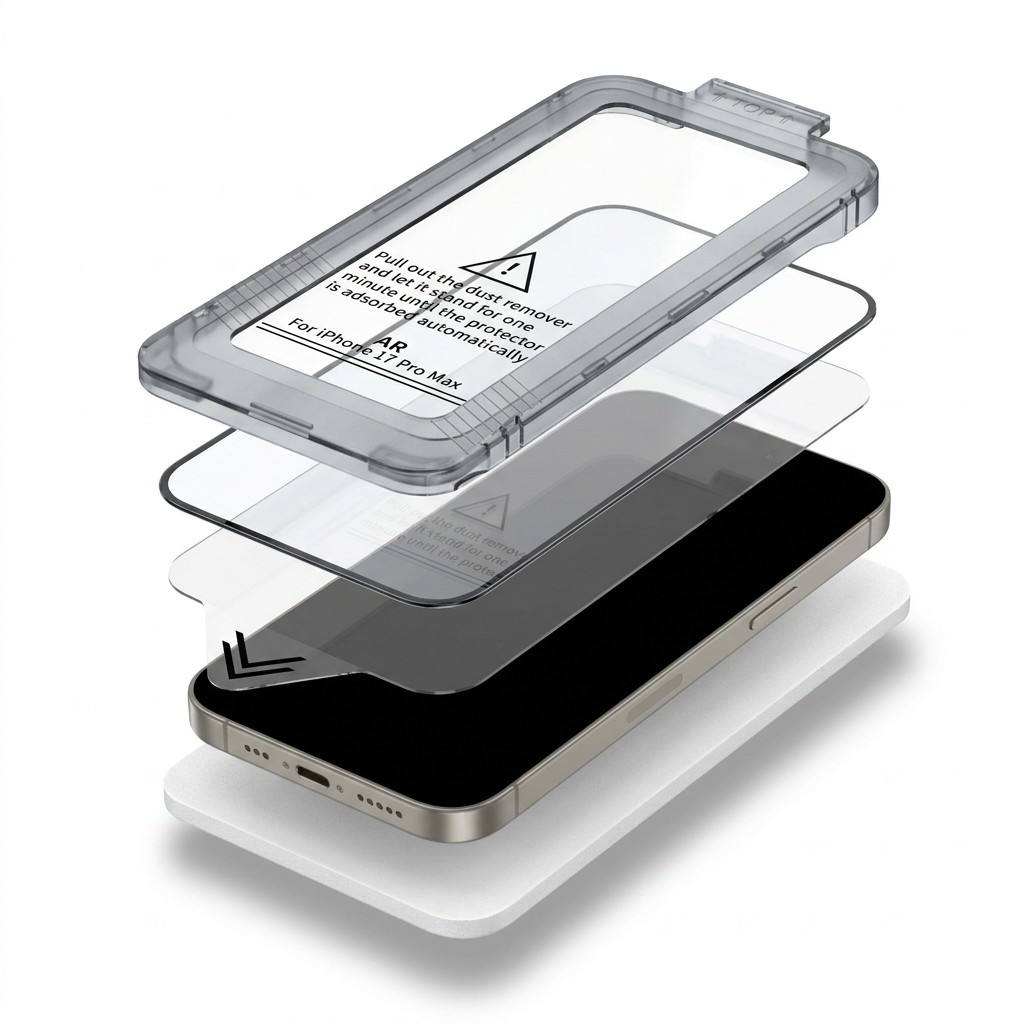
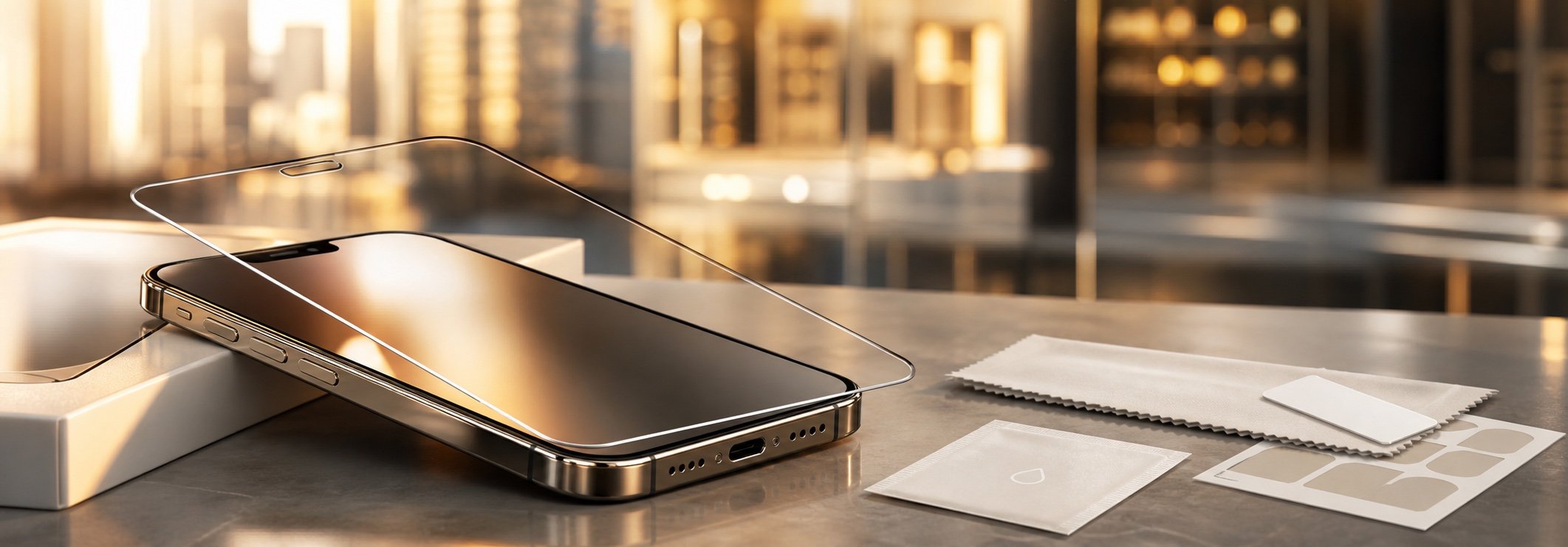
Tempered glass screen protectors are rigid processed-glass sheets. Thermal tempering strengthens glass by controlled heating and rapid cooling; the exact glass composition, tempering process, thickness, edge finishing, adhesive and coating determine the finished protector’s performance.
Glass normally provides a familiar smooth touch, strong scratch resistance and a rigid sacrificial layer. It is widely used on flat phones, tablets, watches, camera lenses and gaming devices. Its limitations are shape-specific inventory, possible edge lifting on incompatible curves and breakage when the protector absorbs a hard impact.
3. PET Film Screen Protectors
PET is a thin, relatively firm polyester film. It is commonly used for basic scratch protection, clear overlays and cost-sensitive programs. PET is thinner and less flexible than many TPU films, so it works best on compatible flat or gently shaped surfaces.
PET can provide good clarity and precise die-cutting, but it does not create the same rigid impact layer or glass-like touch as tempered glass. Buyers should confirm coating, haze, adhesive, edge fit and removal behavior rather than comparing only film thickness.
4. TPU and Hydrogel Screen Protector Films
TPU is a flexible thermoplastic polyurethane family used in clear and functional films. It can conform better than rigid glass to curved or irregular surfaces. TPU grades vary in hardness, elasticity, clarity, abrasion behavior and environmental resistance, so one sample cannot represent every TPU film.
“Hydrogel screen protector” is a product-category name rather than one universal chemical specification. Depending on the supplier, it may describe TPU or other multilayer flexible films marketed for flexibility, light-mark recovery and on-demand cutting. JJT’s hydrogel film range separates TPU, TPH, EPU and PVC product lines so buyers can evaluate the actual format instead of relying on the word “hydrogel” alone.
5. What Does “Ceramic Screen Protector” Mean?
“Ceramic screen protector” is not a single standardized material label across the market. It can refer to a flexible composite film, a coated film or another product sold with ceramic-related marketing. It should not automatically be described as solid ceramic, tempered glass or one fixed polymer.
6. UV-Applied Screen Protectors
UV-applied protection usually uses a liquid optical adhesive that is cured with UV light after alignment. This method can provide fuller adhesive contact on compatible curved displays, but application control matters: ports, speakers and buttons must be protected, adhesive volume must be controlled and curing must follow the specific product instructions.
JJT also offers a separate UV curing film category with HD clear, matte and matt privacy options. This is why “UV protector” should not be treated as a complete material specification: buyers must identify the actual film or glass construction and the curing method.
7. Clear, Matte, Privacy and Paper-Feel Finishes
| Finish | Main benefit | Possible trade-off | Best check |
|---|---|---|---|
| Clear | Prioritizes brightness and image clarity | Reflections and fingerprints remain more visible | Haze, color and surface coating |
| Matte / anti-glare | Reduces reflections and changes finger glide | Can add visible grain or reduce sharpness | White backgrounds, small text and outdoor use |
| Privacy | Limits readable side-angle viewing | Can reduce apparent brightness and shared viewing angle | Front, left and right views on the target device |
| Paper-feel | Adds drag for stylus writing or drawing | Can wear stylus tips and reduce display clarity | Writing feel, tip wear and visual grain |
For privacy technology and its brightness and fingerprint trade-offs, read How Privacy Screen Protectors Work.
8. Which Type of Screen Protector Is Best?
No single type is best for every device and customer. Use the intended use and display construction to narrow the choice.
| Priority | Start with | Why |
|---|---|---|
| Rigid impact layer and familiar glass feel | Compatible tempered glass | Rigid construction and smooth touch |
| Curved coverage and on-demand model cutting | TPU or suitable hydrogel film | Flexible material and broad cutting-library use |
| Basic thin scratch layer | PET film | Thin, precise and cost-efficient for compatible surfaces |
| Reduced reflections | Matte finish on a suitable base material | Surface texture scatters reflected light |
| Side-angle visual privacy | Privacy finish verified on the exact device | Optical layer limits lateral viewing |
| Compatible curved-display full adhesion | Verified UV-applied system | Liquid adhesive can fill the designed interface when correctly installed |
9. Wholesale Sample Evaluation Checklist
- Confirm the actual substrate and layer structure.
- Test clarity, haze, color shift and brightness on the target device.
- Check touch response, edge gestures and under-display fingerprint behavior where applicable.
- Inspect case compatibility, edge lift and curved-screen coverage.
- Record installation time, bubble behavior, adhesive consistency and removal method.
- Compare scratch, impact and bend tests that match the intended product type; do not apply a glass test claim to a flexible film.
- Verify the exact device or cutting template in the compatibility catalog.
10. Common Questions
What are the main types of screen protectors?
The main base-material groups are tempered glass, PET film and flexible polyurethane-based films such as TPU and many hydrogel products. Clear, matte, privacy and paper-feel are functions or finishes rather than separate universal base materials.
Is tempered glass better than plastic film?
Tempered glass is usually preferred for a rigid impact layer and glass-like feel. Flexible film is often better for curved coverage, thin construction and on-demand model cutting. The better choice depends on the device and use case.
Is hydrogel the same as TPU?
Not always. Some hydrogel products use TPU, while other suppliers use the name for different multilayer flexible films. Ask for the exact substrate and specification.
Is a privacy protector a material?
Privacy describes an optical function that limits side-angle viewing. The function may be built into different protector constructions, so the base material and device compatibility still need confirmation.
Can one protector fit every phone?
No finished protector fits every device. Cutting films can cover many models through a template library, while tempered glass pieces are usually model-specific. Cameras, sensors, curves, bezels and cases must be checked.
Build a Screen Protector Mix Around Real Devices
Start with your target models, customer priorities and sales channel. JJT can help compare finished tempered glass, cutting films and functional finishes for a wholesale or OEM program.
Compare Materials and Product Formats
Continue from the overview to a product-level comparison or compatibility check.