Quick answer
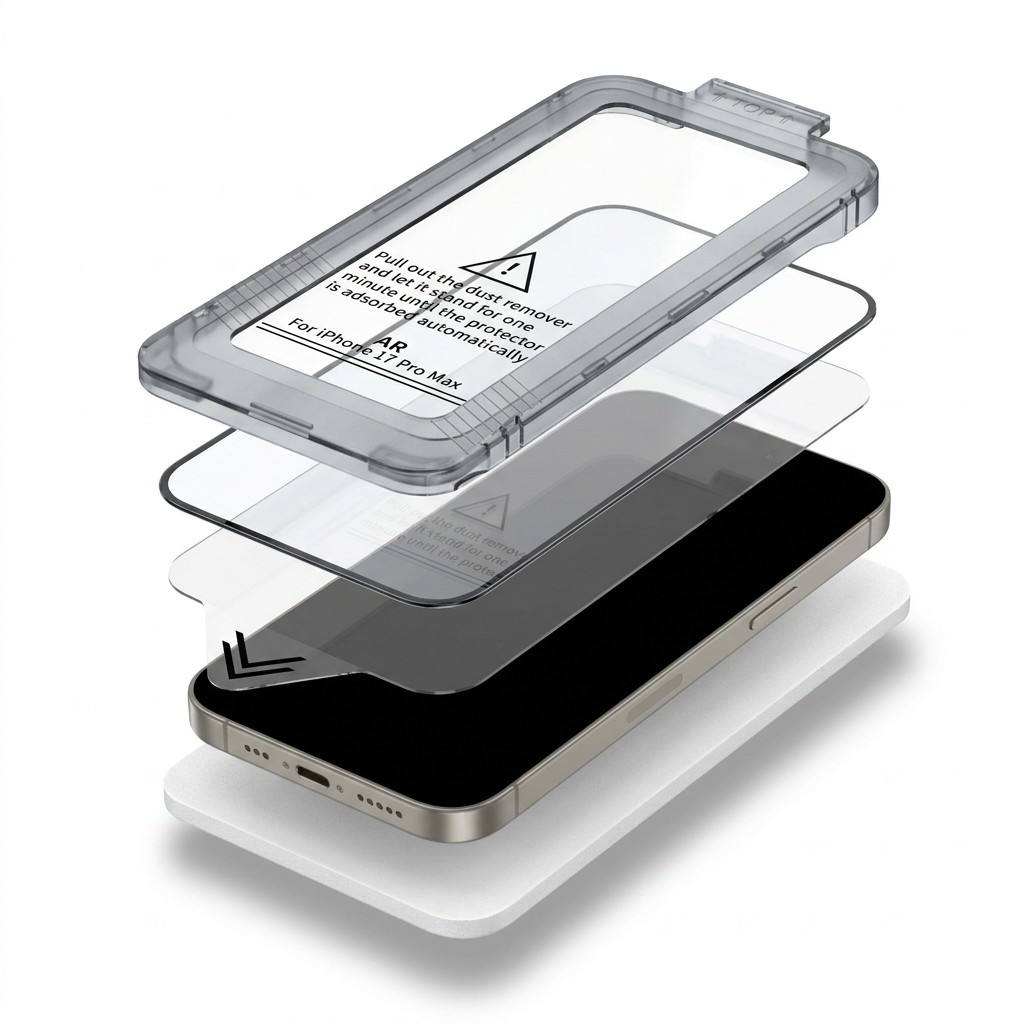
For a curved phone display, choose the protector as a complete system, not by a “3D” label alone. Hot-bent full-adhesive glass offers a rigid glass feel when its curvature matches precisely; liquid-adhesive UV glass can create broad contact but needs controlled installation; flexible TPU, hydrogel or UV-curing film conforms more easily to curves. Confirm the exact model, adhesive coverage, case clearance, fingerprint operation, edge lift and removal before bulk approval.
- Rigid option: model-specific curved glass with verified shape and adhesive coverage.
- Flexible option: TPU, hydrogel or UV-curing film that follows the curve without hot-bent glass.
- Approval rule: test the complete protector, adhesive, device and case combination.
1. What Is a Curved Screen Protector?
A curved screen protector is designed to protect a display whose usable glass or cover surface bends toward one or more edges. The curve may be a small edge transition, a deep side curve or a shaped watch face. The protector must match that geometry while maintaining useful adhesive contact, optical clarity and clearance around the case, speaker, camera and sensors.
“Curved” does not identify one material. A protector can be hot-bent tempered glass, liquid-adhesive UV glass, TPU hydrogel film, another flexible film or a light-cured film system. It also does not mean foldable. A foldable phone’s flexible inner display bends repeatedly at a hinge and needs a product approved for that display. See JJT’s foldable screen protector range for that separate application.
Labels such as 2.5D, 3D, 5D or full coverage are useful only when the supplier defines them. They may describe edge finishing, visual coverage, glass shaping or marketing position. They do not by themselves prove curvature accuracy, full adhesive contact or compatibility.
2. Four Main Options for Curved Displays
| Protector system | How it follows the curve | Main advantage | Main approval risk |
|---|---|---|---|
| Hot-bent full-adhesive glass | Glass is shaped for the model and uses a pre-applied adhesive system | Rigid glass feel and model-specific coverage | Curvature, adhesive map or case clearance may not match |
| Edge-adhesive curved glass | Shaped glass is retained mainly around a defined perimeter | Simple dry installation on some designs | Central contact, sound, touch or visible gap must be checked |
| Liquid-adhesive UV glass | Liquid adhesive spreads under shaped glass and is cured with a supplied lamp | Broad optical contact on a compatible curve | Overflow, bubbles, alignment and incomplete cure |
| TPU, hydrogel or UV-curing film | Flexible substrate conforms to the shaped surface | Curve coverage with a thin, flexible construction | Edge lift, stretching, surface feel and installation consistency |
Huawei’s screen film guide illustrates that curved coverage can be delivered with different film materials and finishes. It should not be read as proof that every film fits every phone. Exact device geometry and the complete product construction still control the result.
3. Hot-Bent and Pre-Adhesive Curved Glass
Hot-bent glass is formed so its edge profile follows the intended display. A successful system needs more than the correct outline: the glass curvature, flat central region, adhesive thickness, adhesive coverage and black-border position must all align with the real device.
Full-adhesive constructions place adhesive across the intended viewing area rather than relying only on a narrow perimeter. Edge-adhesive designs can be easier to position, but the buyer should not assume that visual coverage means full optical contact. Inspect the center and curved zones under reflected light, run touch tests across a grid and listen for hollow or variable contact.
Rigid glass is not automatically the most protective choice for every curved phone. Edge finish, strengthening process, surface damage, adhesive support and case contact all affect the installed system. Use the JJT tempered glass range as the commercial starting point, then approve the exact device sample rather than a generic curve label.
4. Liquid-Adhesive UV Glass
A UV glass kit normally combines model-specific glass, liquid optically clear adhesive, a fixture, opening protection or absorbent pieces and a curing lamp. OnePlus’s official UV tempered glass manual shows how glass, liquid adhesive, a fixture, absorbent strips and UV curing operate as one system. Mixing unrelated glass, liquid and lamps removes that controlled design.
The liquid can create broad contact beneath curved glass, but installation has more failure points than ordinary peel-and-stick glass. The phone must be level; the correct liquid quantity must spread without bubbles; vulnerable openings must be sealed; alignment must be stable before curing; and overflow must be removed at the specified stage.
The exact OnePlus steps and times belong to that product, but they demonstrate why a UV installation is not a universal “drop glue and shine a lamp” process. Samsung also warns that misused curing liquid can enter receivers, speakers or buttons.
5. TPU, Hydrogel and UV-Curing Film
Flexible film does not need to reproduce a rigid glass curve. It can conform to the display shape during installation, making it a practical option for deep curves, varied model demand and on-demand cutting programs. Flexibility does not make every film identical: substrate, thickness, surface coating, adhesive and liner design change clarity, feel, recovery and edge retention.
JJT’s hydrogel film range supports material and function choices for cutting-machine programs. The TPU hydrogel options include confirmed thicknesses from 0.13 to 0.21 mm depending on function. These product specifications are examples of JJT’s actual range, not a claim that one thickness suits every curved screen.
UV-curing screen protector film is different from UV liquid-adhesive glass. JJT’s film is a flexible product family whose adhesive is activated through its defined light-curing process; it does not use a separate rigid glass sheet floating on dispensed liquid. Buyers must keep “UV glass” and “UV film” separate in quotations, packaging and training.
6. Compare Coverage, Adhesive, Fingerprint and Case Fit
Coverage should be measured against the active display, visible border and case opening. A protector can reach close to the display edge yet still be case-friendly if a controlled clearance remains. Another protector can look smaller but lift because the case lip contacts one corner. “Full cover” and “case-friendly” are not opposites; both need dimensions and a real case test.
Adhesive coverage should be documented, not guessed from the outside. Ask the supplier for an adhesive map or use an agreed inspection method to identify full-area, patterned or perimeter contact. Inspect for white edges, Newton-ring-like optical variation, dust channels, lift and changes after temperature and handling cycles.
For fingerprint readers, test rather than promise. Samsung notes that some uncertified protectors may interfere with in-screen fingerprint sensors and that fingerprints may need to be registered again. Protector material, adhesive, bubbles, thickness and sensor design can all contribute, so a successful result on one device does not approve another model.
7. Device Compatibility Checklist
- Confirm the exact model and region. Similar device names can use different dimensions, speakers or sensors.
- Record the screen geometry. Mark the flat active area, curved transition, edge radius and protected area.
- Check every opening. Confirm speaker, camera, proximity sensor, microphone, stylus and button clearance.
- Define adhesive coverage. Record full-area, patterned, edge-only or liquid-dispersion construction.
- Test with target cases. Use actual best-selling cases and inspect every edge after repeated removal and refitting.
- Test touch and biometrics. Use a grid, keyboard edges, gestures and repeated fingerprint unlock attempts.
- Inspect after settling. Recheck edge lift, bubbles and optical change after the product’s stated settling or cure period.
- Validate removal. Confirm the protector can be removed by its approved method without unacceptable residue or device stress.
Use the JJT compatible models center to begin model confirmation. A database match is the start of approval, not a substitute for testing the final device, protector, case and installation method.
8. Why Curved Protectors Lift at the Edge
Edge lift is usually a system mismatch rather than a single material defect. Common causes include wrong curvature, dust or skin oil, adhesive that never contacted the final curve, a stretched film trying to recover, case pressure, incomplete UV cure, temperature exposure or a protector that was positioned off-center.
Do not repair an unknown system with random edge glue, heat or solvent. First identify the protector type and failure location. For dry-applied film, follow its stated settling and edge-finishing method. For liquid-adhesive glass, stop if adhesive approaches an opening. The JJT troubleshooting center provides general diagnosis, while the exact product instructions remain the controlling source.
9. Wholesale Sample Validation Matrix
| Test | Record | Approval question |
|---|---|---|
| Fit and curvature | Edge gap, border position, opening alignment | Does every point match the target model? |
| Adhesive contact | Contact map, bubbles, white edge, lift | Is contact stable across center and curve? |
| Optical result | Clarity, reflection, rainbow pattern, border intrusion | Does the protector change visible content? |
| Input function | Touch grid, edge gestures, stylus and fingerprint repetitions | Do all intended inputs pass consistently? |
| Case interaction | Case models, insertion cycles, edge contact | Does the case push or lift the protector? |
| Installation | Time, rework, dust, overflow, first-time installer pass rate | Can the sales channel install it repeatably? |
| Removal | Method, force, residue, coating and device condition | Can it be serviced safely? |
Approve more than one sample and retain the approved protector, packaging, adhesive lot and instructions. If glass shape, adhesive, liner, lamp or installation jig changes, treat it as a controlled revision and repeat the affected tests.
10. Which Curved Protector Should You Choose?
- Choose hot-bent full-adhesive glass when a precise model-specific shape, rigid feel and repeatable dry installation have passed device and case tests.
- Choose liquid-adhesive UV glass when broad contact on a curved display is required and the channel can control sealing, liquid flow, curing and cleanup.
- Choose TPU or hydrogel film when flexibility, curve conformity, cutting-machine coverage and lower break risk are more important than a rigid glass feel.
- Choose UV-curing film when the approved JJT film construction and light-curing workflow match the target model and channel.
Do not select from this list without samples. The correct answer is the system that passes the target market’s real device, case, installation, function and removal tests.
11. Common Questions
What type of screen protector is best for a curved screen?
There is no universal best type. Hot-bent glass, liquid-adhesive UV glass and flexible films solve different fit and installation problems. Choose only after testing the exact device, case, fingerprint sensor and installation process.
Does tempered glass work on curved screens?
Yes, when the glass shape and adhesive system are designed for the exact curve. A generic flat protector or poorly matched curved glass may leave gaps, lift or interfere with cases.
Is UV glass better than hydrogel for curved screens?
UV glass can provide a rigid surface and broad adhesive contact, but installation requires liquid control and curing. Hydrogel is flexible and easier to conform to many curves. The better option depends on channel skill, device fit and required feel.
Why does my curved screen protector lift?
Typical causes include a curvature mismatch, contamination, incomplete adhesive contact, film stretch, case pressure, misalignment or incorrect curing. Identify the construction before attempting a repair.
Can a curved screen protector affect fingerprint unlock?
It can. Material, adhesive, thickness, bubbles and sensor design may affect recognition. Test repeated unlocking on the exact phone and follow the device maker’s setup guidance.
Is a curved screen the same as a foldable screen?
No. A curved phone cover surface has a fixed shape. A foldable inner display repeatedly bends at a hinge and needs a protector approved for that flexible display and service policy.
Approve the Complete Curved-Screen System
JJT supports tempered glass, hydrogel and UV-curing film programs. Share the target models, cases, channel and test priorities so the correct construction can be sampled before bulk production.
Compare Curved-Screen Materials
Match the substrate and installation method to the target device.